
 Luxury Watches
 Diamonds
 Jewelry
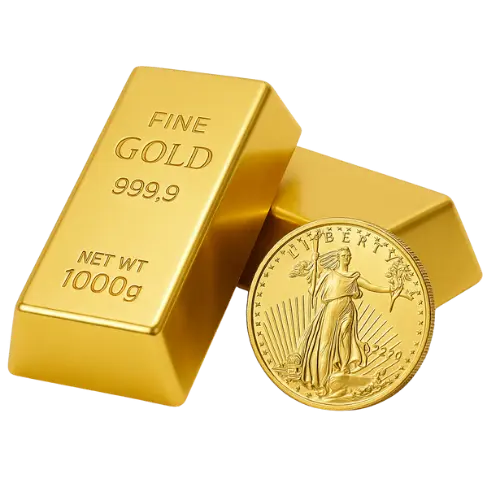 Gold
 Gemstone
 Estate Jewelry
 Silver
 Platinum
Selling gold sounds simple until you’re standing at a counter watching a scale and wondering what the number means. It doesn’t have to be a mystery. Every honest gold offer is built from three numbers — weight, karat, and the spot price — multiplied together in a formula you can check on your own phone. This guide walks through each one, in the order it happens in our store at 67 W 47th Street, so you can follow along at our counter or anyone else’s.
The 60-second version
Your pieces are sorted and tested in front of you. Each piece is weighed, and the scale shows you the number. The karat stamp (or a test) tells us what fraction of the piece is pure gold. That pure-gold weight is priced against the day’s spot price for gold. The result is the piece’s melt value — and a buyer’s offer is built from there. If a buyer won’t show you the weight, state the karat, or explain the price they used, you don’t have an offer. You have a number pulled from the air.
Step 1: Your gold is sorted and tested in front of you
A typical bag of jewelry is a mix: a 14K chain, an 18K ring, a bracelet that’s gold-filled rather than solid, maybe a coin. Because karat changes the math, pieces are sorted by purity first. Most solid pieces are stamped — look for tiny marks like “14K,” “585,” “18K,” or “750” on a clasp, inside a ring band, or on an earring post.
Stamps can be worn, missing, or simply wrong, so a careful buyer tests. Depending on the piece, that can mean an electronic gold tester, a traditional acid test on a touchstone (which can leave a faint mark, so the buyer should ask before using it), or other non-destructive checks. At New York One Pawn, testing happens in front of you, at the counter — and you can ask what method is being used and why. Pieces that turn out to be gold-plated or gold-filled aren’t solid gold and are priced very differently; a good buyer will show you the test result rather than just announcing it.
Step 2: Weight — grams, pennyweight and troy ounces
Gold is weighed three ways in this business, and the units cause most of the confusion:
- Grams (g) — the unit most digital scales show, and the easiest to verify.
- Pennyweight (dwt) — an older American jewelry-trade unit. 1 dwt = 1.555 grams.
- Troy ounces (ozt) — the unit the spot price is quoted in. 1 troy ounce = 31.1035 grams = 20 dwt. Note that a troy ounce is heavier than the ounce on a kitchen scale (28.35 g), which is why “an ounce of gold” means the troy one.
Before your pieces go on, the scale should read zero — ask to see it. Your gold is weighed in front of you, and at our counter you see the weight yourself rather than hearing it reported from another room. If a quote is given per pennyweight, convert it: multiply the dwt by 1.555 to get grams, and make sure any offer you compare elsewhere is in the same unit. Many “great” offers shrink the moment the units match.
Step 3: Karat — how much of your piece is actually gold
Karat measures purity as a fraction of 24:
| Stamp | Karat | Pure gold content |
|---|---|---|
| 417 | 10K | 41.7% |
| 585 | 14K | 58.3% |
| 750 | 18K | 75.0% |
| 916 | 22K | 91.7% |
| 999 | 24K | ~99.9% |
Jewelry is alloyed with other metals for strength — pure 24K gold is soft enough to bend with your fingers — so a 20-gram 14K chain contains about 11.7 grams of pure gold, not 20. Non-gold parts also come off the weight: gemstones, hollow cores, steel springs in clasps, and watch movements are not gold and shouldn’t be priced as if they were. A transparent buyer weighs or accounts for them openly instead of quietly rounding your weight down.
Step 4: The spot price and the melt-value formula
The spot price is the live market price for one troy ounce of pure gold. It moves all day, every trading day. The formula every buyer starts from is:
Melt value = (weight in grams ÷ 31.1035) × karat fraction × spot price
Say a 14K chain weighs 15.5 grams. That’s about half a troy ounce of alloy (15.5 ÷ 31.1035 ≈ 0.498 ozt), of which 58.3% is pure gold — roughly 0.29 troy ounces of pure gold. Multiply by the day’s spot price and you have the melt value: what the raw metal alone is worth before it becomes anything else.
An offer will be below melt value, and that gap is not automatically a rip-off. The buyer has to refine or resell the metal, test and handle each piece, absorb the risk that the spot price drops while the gold sits in the safe, and run a store on 47th Street. What you should insist on is seeing the inputs — weight, karat, and the spot price used — so the gap is a number you can judge, not a fog. Also compare offers on the same day: with a moving spot price, Tuesday’s quote and Friday’s quote aren’t measuring the same market.
One more distinction: an offer to buy is not an appraisal. An insurance appraisal estimates replacement cost for a policy and is usually far higher than any buyer’s offer. They’re answering different questions.
What to bring
- The pieces themselves — including broken chains and single earrings; scrap gold is bought by the same math.
- A government-issued photo ID. Reputable buyers record who sold an item; expect to show it.
- Any paperwork you have — receipts, certificates, prior appraisals. Not required, but useful context.
- Coins in their capsules or tubes, if you’re selling bullion — purity is stamped on the piece, which makes coins the fastest evaluation of all.
Red flags to walk away from
- The scale is out of your sight, or the buyer won’t state the weight or the unit.
- Testing happens in a back room, or the result is announced without being shown.
- The offer is one lump sum for a mixed lot with no per-karat breakdown.
- Fees appear only after you’ve agreed, or the price quoted changes mid-conversation.
- Pressure: “this price is only good for the next five minutes.” The spot price moves, but not like that.
- Mailing your gold to an address with no written terms for insurance, return, or what happens if you decline the offer.
Selling gold at 67 W 47th Street
At New York One Pawn, the process above is the process: your gold is tested in front of you, you see the weight, and you see the price it’s based on before you decide anything. There’s no obligation attached to an evaluation.
We’re at 67 W 47th St in the Diamond District, open Monday–Friday 9:30 AM–6:30 PM and Sunday 10 AM–5 PM (closed Saturday). Walk in, or call us at (212) 278-8282 with questions first — and feel free to check our math. That’s rather the point.


