
 Luxury Watches
 Diamonds
 Jewelry
 Gold
 Gemstone
 Estate Jewelry
 Silver
 Platinum
Of everything a person might sell at a gold counter, coins and bullion are the most straightforward, because the same facts that make them easy to evaluate make them easy to sell well. A ring has to be tested, weighed, and interpreted. A bullion coin announces itself: its weight, its purity, and its maker are stamped into its face. This guide covers how coins and bars are evaluated in-store, what the common issues mean, and the few handling details that are actually worth your attention.
Why coins are the simplest gold to evaluate
Every gold offer starts from three numbers — weight, purity, and the day’s spot price. Jewelry makes a buyer work for the first two: karat stamps wear off, stones and findings have to be accounted for, testing takes time. A mint-issued bullion coin answers both questions on its face. Its total weight and its gold content are set by the mint that struck it, and its design is a published, recognizable standard that a buyer verifies at a glance and confirms on the scale.
That simplicity has a practical consequence: coin evaluations are fast, and the reasoning behind an offer is easy to follow and easy to check. If you have both jewelry and coins to sell, expect the coins to be the shortest conversation of the visit.
Purity and weight are stamped on the piece
The major bullion coins differ in recipe, and knowing which you hold takes ten seconds of reading:
- South African Krugerrand — struck in 22-karat gold alloy for durability. The coin weighs more than a troy ounce in total and contains exactly one troy ounce of pure gold; the extra weight is the alloy that makes it hard-wearing. Sellers often misread this coin: its total weight and its gold content are two different numbers, both by design.
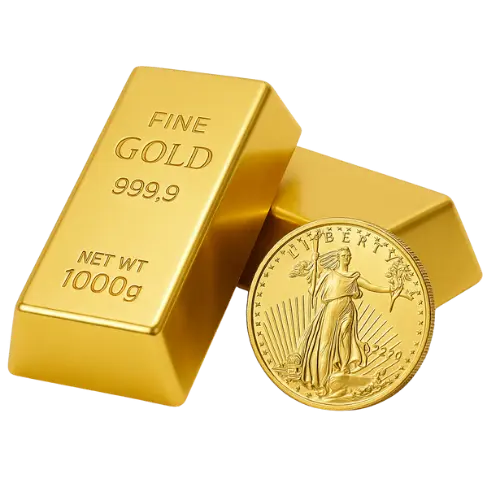
- American Gold Eagle — also 22-karat, also alloyed for circulation-grade toughness, and made in fractional sizes as well as the one-ounce. The gold content is the stated weight on the coin.
- Canadian Maple Leaf — struck in essentially pure gold (.9999 fine), which makes it beautiful and also soft: pure gold dents and scratches easily, and Maple Leafs often show it.
Mint bars follow the same logic — weight and fineness are stamped on the bar alongside the refiner’s mark, and sealed bars carry an assay certificate in the packaging. In every case, the piece is its own documentation.
Common coins buyers see (Krugerrands, Eagles, Maple Leafs)
Beyond the big three above, counters regularly see Austrian Philharmonics, Australian Kangaroos, British Britannias, and pre-1933 American gold coins, along with one-ounce and fractional bars from recognized refiners. Fractional pieces — tenths, quarters, halves — are evaluated by the same stamped weight and purity.
One category deserves a separate sentence: older and collectible coins. Most bullion is valued for its gold content, but some coins — early dates, low mintages, exceptional condition — carry numismatic value beyond the metal. Don’t assume a coin is “just bullion” because it’s old; a careful evaluation flags the pieces that deserve a second, collectible-aware look. If you’ve inherited coins in albums or envelopes with handwritten dates, bring them exactly as they are.
Tubes, capsules and grading — what matters and what doesn’t
Storage and grading cause sellers more anxiety than they deserve. The plain facts:
- Capsules and tubes protect coins from handling, and mint packaging is nice to have — bring coins as they’re stored. But for standard bullion, packaging is protection, not value: a common-date Krugerrand out of its tube is the same coin, with the same gold content.
- Handling matters modestly. Hold coins by their edges, don’t clean them — cleaning is the one thing that can genuinely harm a collectible coin’s standing — and don’t polish anything “to make it presentable.”
- Professional grading (a coin sealed and graded by a grading service) is present on some pieces and absent on most. For common bullion, grading rarely changes the evaluation, because the gold content is the story. For genuinely collectible pieces, an existing grade is useful documentation. Either way, there’s no need to send coins out for grading before selling them.
- Condition on bullion is mostly a question of damage: heavy dents or edge damage on a pure-gold coin can matter at the margins, while normal handling marks on a 22-karat coin are expected.
In-store testing and offers
At New York One Pawn, 67 W 47th St in the Diamond District, coins and bars are evaluated at the counter in front of you. The piece is identified, weighed — you see the weight on the scale yourself — and its dimensions and appearance are checked against the mint’s standard for that issue, with further non-destructive testing available where a piece calls for it. The offer is then explained in terms of the coin’s stamped gold content and the day’s spot price, so you can follow the arithmetic from the face of the coin to the number you’re given. Bring a government-issued photo ID if you decide to sell; reputable buyers record purchases.
Bring coins in their capsules to New York One Pawn, 67 W 47th St, for an evaluation at the counter — open Monday–Friday 9:30 AM–6:30 PM and Sunday 10 AM–5 PM (closed Saturday) — or call (212) 278-8282 first. More on how gold is bought here: Sell your gold.


